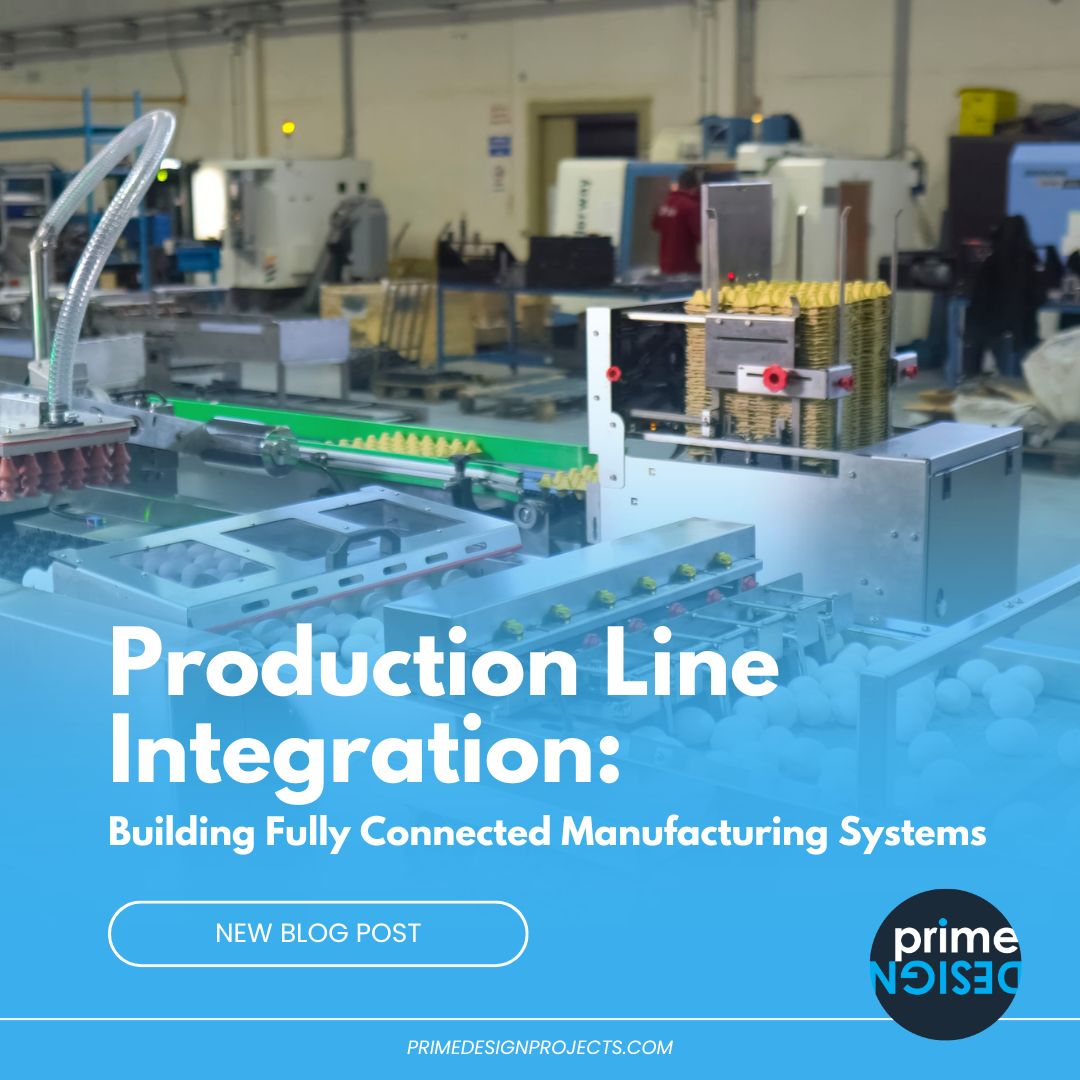
Production Line Integration: Building Fully Connected Manufacturing Systems
Production line integration is one of the most important factors in determining whether a manufacturing facility achieves its true operational potential. Even when individual machines are high quality, performance often falls short when the overall system has not been properly designed to work as a single, coordinated line. In modern FMCG and regulated manufacturing environments, success is no longer driven by equipment alone. It depends on how effectively equipment, controls, people, materials, and processes are brought together into one stable and efficient system. Prime Design Projects Ltd has over 30 years of experience delivering production line integration projects across dairy, beverage, nutrition, packaging, and complex manufacturing sectors. Across all of these projects, one theme is consistent: equipment selection is only the starting point, integration is what determines performance. Production line integration is the process of ensuring that all parts of a manufacturing line operate together as one coherent system. This includes mechanical alignment of machines and conveyors, communication between control systems, connection into factory utilities, and integration with higher-level systems such as MES, SCADA, and ERP platforms. It also extends to how operators interact with the line and how materials and packaging components are managed throughout production. A production line is not a collection of separate machines. It is a single interconnected system that must behave predictably under real operating conditions. Poor integration typically presents as frequent stopping and starting, unstable running speeds, product accumulation between machines, excessive waste, and inconsistent quality. These issues often lead to frustration on the shop floor and reduced confidence in the line’s capability. The underlying causes are usually that individual machine and people behaviour have not been fully considered within the wider system design. Each machine within a production line has its own operating characteristics. Some run at constant speed, others cycle, and many require buffering or specific conditions to maintain stability. When these behaviours are not properly balanced, the line becomes unstable. Successful integration requires designing the system around these characteristics so that variation in one area does not negatively impact the rest of the line. This is where true performance stability is achieved. One of the most complex areas of production line integration is control system architecture. Modern manufacturing lines include multiple technologies working together, such as PLCs, vision systems, labellers, fillers, conveyors, printers, and inspection equipment. These systems need to be aligned correctly and communicate efficiently. It is common to see mixed control platforms, inconsistent protocols, or legacy systems that limit performance. These issues lead to delayed responses, poor synchronisation, and inefficient line behaviour. A well-designed integration approach ensures that all equipment communicates effectively and responds consistently to line conditions, regardless of supplier or technology differences. Integration is not limited to software and controls. Physical design plays an equally important role in performance. Machine spacing, buffering capacity, and product flow direction all influence stability. If equipment is placed too tightly together, minor disturbances can cascade through the line. If spacing is too generous, efficiency and footprint utilisation can be negatively impacted. Operator access, maintenance clearance, hygiene zoning, and material handling routes also need to be considered. People as Part of the Integrated System A production line is operated by people as well as machines, which means human factors must be included in the integration design. Operator behaviour, training levels, shift patterns, and escalation processes all influence line performance. Even well-designed systems can underperform if operators are not fully aligned with how the line is intended to operate. Keeping production teams engaged, consistent training, clear procedures, and structured communication between shifts are essential to maintaining stable performance over time. Every integration project carries technical and operational risk, particularly when introducing new equipment into existing systems. These risks can relate to mechanical compatibility, electrical integration, control system limitations, safety requirements, or production disruption during installation. There are also commercial and operational risks linked to packaging materials, spare parts, maintenance access, and supply chain stability. Identifying these risks early is essential to avoid issues during commissioning and ramp-up. A structured risk assessment approach helps ensure that integration challenges are understood and mitigated before installation begins. One of the most effective ways to improve integration outcomes is through simulation modelling and virtual validation. By modelling line behaviour before finalising the design, it is possible to assess throughput, identify bottlenecks, test buffer performance, and evaluate different operating scenarios. This allows potential issues to be identified early, reducing the likelihood of expensive rework or delays during installation and commissioning. Simulation also helps support better decision making around layout, staffing, and equipment configuration. Even with strong design and planning, production lines require fine tuning once they are installed and running under real production conditions. Commissioning is where system behaviour is validated against actual product, real operators, and live production demands. This stage often involves adjusting control parameters, refining buffering strategies, and resolving small but important interaction issues between machines. Stable performance is achieved when the line consistently operates under normal production conditions without frequent intervention or disruption. When production line integration is not executed effectively, the consequences are long lasting. Poor integration leads to reduced efficiency, increased waste, higher operating costs, and unstable production output. It can also negatively impact workforce morale, as operators are often left managing instability rather than running an efficient system. Once embedded into daily operations, these issues become difficult and costly to correct. Prime Design Projects Ltd delivers integrated manufacturing solutions that align equipment, process, and operations into a single coherent system. Our expertise includes production line integration design, control system architecture, manufacturing feasibility studies, simulation modelling, and on-site implementation support. We also use tools such as 3D laser scanning and 3D modelling to validate physical integration and ensure alignment between design and installation. With extensive experience across FMCG and regulated industries, we focus on delivering systems that perform reliably in real production environments, not just theoretical designs. For support with production line integration, control system design, or manufacturing system optimisation, contact our team. Address Email PhoneProduction Line Integration: Building Fully Connected Manufacturing Systems
What Production Line Integration Means
Why Integration Has Such a Large Impact on Performance
The System View of a Production Line
Control Systems and Automation Integration
Physical Flow and Layout Considerations
Risk Identification Before Implementation
The Role of Simulation and Digital Validation
Commissioning and Real-World Stabilisation
The Impact of Poor Integration
How Prime Design Projects Supports Production Line Integration
Contact Prime Design Projects
Centurion House
London Road
Staines-Upon-Thames
TW18 4AX
info@primedesignprojects.com
+44 (0)1784 668188